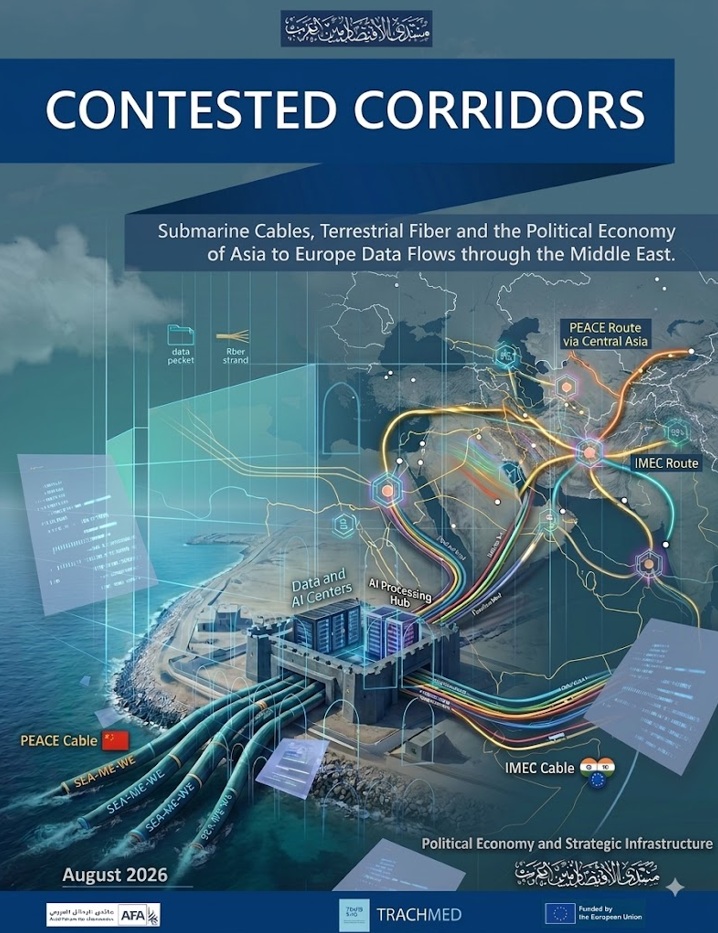
Submarine Cables, Terrestrial Fiber and the Political Economy of Asia to Europe Data Flows through the Middle East
Ninety-nine per cent of intercontinental internet traffic moves through submarine cables, and between twenty and thirty per cent of it crosses the Middle East. This paper asks why, within a period of thirty-six months, at least six competing corridor projects have been announced to carry that traffic between Asia and Europe, and what the competition implies for the states that host it? It treats the cable network as a topology of political power rather than as a telecommunications asset, and applies four analytical instruments to it: the theory of weaponized interdependence, which locates coercive capacity at network chokepoints; the theory of locational rent, which explains why transit geography generates income and why that income invites competitive entry; the theory of asset specificity, which explains why a twenty-five year sunk cable locks in a political alignment; and the literature on hedging and omni-alignment in small and middle power foreign policy. Drawing on a structured focused comparison of eight cases, namely the United Arab Emirates, Saudi Arabia, Israel, Türkiye, Egypt, Iraq, Syria and Oman, the paper advances three findings. First, route selection in this corridor competition is determined by political admissibility, in particular on the Palestinian question, rather than by engineering cost or latency, and the fiber route has consequently become a mechanism for expressing alignment on the Palestinian question. Second, the projected demand from Gulf artificial intelligence compute converts route redundancy from a resilience option into a capacity requirement, with incremental Asia to Europe transit demand of between 80 and 1000 terabits per second (Tbps) by 2030 against an installed base of 500 to 600. Third, the rent position of Egypt, which is the only mandatory node in the present system, is simultaneously the source of its fiscal leverage and the principal cause of the bypass investment now under way. The paper closes with three scenarios for 2030 and a set of policy implications for host states, investors and multilateral bodies. This research was realized in a collaboration secondment with the Arab Forum for Alternatives (Lebanon) in the context of the TRACHMED research mobility project funded by the European Union.